Apparently NBC is airing some lame-brained miniseries which attempts to retell some part of Church history. So strange -- it's not even Easter yet. I tell ya' -- no matter how dumb, there are people who will believe anything. I blame the public schools. ;0)
The mini-series, which airs Sunday, January 25th, and Monday, January 26th, is based on the 2005 novel, The Last Templar, written by Raymond Khoury. The novel was on The New York Times bestseller list for 22 months and sold over four million copies.
The novel is similar in many ways to The Da Vinci Code, including its use of the Templars, its reliance on the "Gnostic gospels," and its claim that ancient documents provide definitive proof that Jesus Christ was not divine. USA Today, for example, writes of the mini-series, "The last time you saw this template, it was called The Da Vinci Code."
The novel, according to its website, is "a thought-provoking exploration of religion in today's world, and of historic fact versus faith, particularly regarding the origins of the Catholic Church. Through the investigation into the Templars' history and their mysterious discovery, and though the interplay between Tess - the agnostic, scientific skeptic - and Reilly, who turned to the Church after his father shot himself when Reilly was just a boy, the book presents a spirited look at the early days of the Church and invites the reader to question matters which most of us take at face value."
Carl and Sandra examine some of historical claims of the novel and discuss the ongoing popularity of the Templar mythology.
Listen to mp3 audio file (25 minutes):
• RIGHT CLICK to download the mp3 audio file (11.5 megs)
Lectures in Dominican history given in 1986 to Dominican friars of the Province of St. Joseph by Fr. John Frederick Hinnebusch, O.P. of the Dominican House of Studies, Washington, D.C. Lecture 23. Audio, 61 min.
In Lecture 23 Fr. Hinnebusch discusses the sources for Dominican History in the 18th and 19th centuries, new editions of the Dominican constitutions, Dominican legislation and governance, the Masters General, Gallicanism, the Hapsburgs and the Dominicans, the French Revolution, and the development of the Dominican Order in the modern period. mp3 format
FYI, you can get a few new premium Christian audiobooks for free at Christianaudio.com. Registration is required and it's a Protestant site (so be careful what you download) but they're really very good about not spamming you -- the registration is totally worth the price you pay (free). In any case, here's my shopping cart:
Here are a couple of lectures on St. Augustine from the University of Sydney:
Augustine, City of God, download, listen. [Augustine thinks not in opposites but in terms of an order with many levels. Manicheanism; his theory of evil. Structure of the City of God. Some themes: Fate, foreknowledge and free will; the greatness of the Roman empire, honour as a simulacrum of virtue; the two cities; the possibility of cooperation between citizens of the two cities.]
Augustine on Freewill and Predestination, download, listen [Augustine's conception of free choice. According to Pelagius, living the good life is up to you. Augustine's dissatisfaction with Pelagius' doctrine. According to Augustine, after the Fall, human beings need God's help for each and every good act of choice. This help is gratuitous, not earned or deserved as a right. Needed also is the gift of perseverance; salvation or damnation depends on the state in which one dies. Predestination. Adam's sin attributed to all human beings. The basis for Augustine's doctrine in the bible (see extracts from bible). Later contests over Augustine's doctrine: Ockham, Bradwardine and Gregory of Rimini, Luther, Calvin, Molina, Jansen, Arnauld, Arminius.]
Here are a couple of lectures on a couple of Doctors of the Church, from the University of Sydney's Medieval program. I haven't listened yet, so if there's some...er...not-quite-right stuff in here be sure to drop a notice in the comment box.
Bede, Ecclesiastical History of the English People, download; listen. [The importance of history within the western intellectual tradition. Medieval historians, like the classical predecessors who influenced them, were rhetors, skilled in the technique of 'invention'. Their rhetorical background explains: (i) their use of attributed direct speech; (ii) their predilection for hagiographical stereotyping; (iii) their concern for literary style. Christian aspects of medieval history writing: (1) conception of history as a comprehensible whole; (2) a concern with time and accurate dating; (3) explanatory themes derived from the biblical (especially Old Testament) conception of history.]
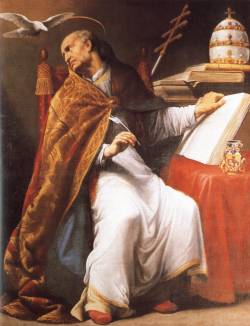
Gregory the Great, download, listen[Pope Gregory 1 (the Great) was the highly influential moral teacher of Europe between 600 and 1100. Manuscript survivals, library catalogues and citations by many other writers show his popularity. His Letters were mined for information; his works of biblical exegesis, especially his Moralia on the book of Job, were regarded as models of allegorical exposition by later writers and enshrined practical moral advice with a Stoic bent; his Pastoral Care provided a model of leadership for the secular clergy; his Dialogues introduced a new model of sanctity based on everyday Christian virtues. In general, his writings portrayed a world where the boundaries between the natural and supernatural were porous and advocated the individual's obligations to other members of the body of Christ.]
Shamelessly stolen from my competition over at A Catholic iPod:
The words of the Bishop of Antioch, The Saint Ignatius Series narrated by Joe McClane of The Catholic Hack Podcast. Download all seven epistles. Donations here, are not required but appreciated to be used to produce CDs for mass distribution.
From Spirit Catholic Radio in Nebraska comes a series of programs from perhaps the foremost patristics scholar in America today. Mike Aquilina's work has been rather exhaustive and he's exceedingly good at making the early Fathers accessible. If you've ever been confronted by someone who claims that the Early Church wasn't Catholic or that the Catholic Church was invented by Constantine (ala Dan Brown), be sure to be prepared by having listened to at least a few of these programs.
Mike is author or editor of more than a dozen books on Catholic history, doctrine, and devotion. He is vice president of the St. Paul Center for Biblical Theology based in Steubenville, Ohio.
This blog is dedicated to bringing you free orthodox Catholic audio. If you have a tip or would like to report a broken link, please e-mail me by clicking the link above.
"Faith then cometh by hearing; and hearing by the word of Christ."
Rom 10:17(DRV)
If you see a product review on this site it's because the Catholic Company is giving me stuff to do it. They don't ask me to be kind, but I do get stuff. FYI.
 Apparently NBC is airing some lame-brained miniseries which attempts to retell some part of Church history. So strange -- it's not even Easter yet. I tell ya' -- no matter how dumb, there are people who will believe anything. I blame the public schools. ;0)




 Mike Aquilina – October 2007


 Second Annual Father Ronald Lawler Memorial Lecture
 Inaugural Father Ronald Lawler Memorial Lecture

 This blog is dedicated to bringing you free orthodox Catholic audio. If you have a tip or would like to report a broken link, please e-mail me by clicking the link above.
"Faith then cometh by hearing; and hearing by the word of Christ."
Rom 10:17(DRV)
This blog is dedicated to bringing you free orthodox Catholic audio. If you have a tip or would like to report a broken link, please e-mail me by clicking the link above.
"Faith then cometh by hearing; and hearing by the word of Christ."
Rom 10:17(DRV)
